Waking up after a night of sleep is a blessing from Allah. Islam teaches Muslims to remember Allah from the moment they open their eyes and begin a new day. One of the most beautiful Sunnah supplications to recite after waking is the waking-up dua. It expresses gratitude for being given life again after sleep and reminds believers that the final return is to Allah.
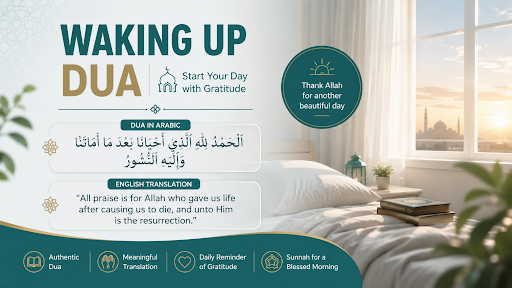
Waking Up Dua in Arabic
The authentic dua after waking up is:
الْحَمْدُ لِلَّهِ الَّذِي أَحْيَانَا بَعْدَ مَا أَمَاتَنَا وَإِلَيْهِ النُّشُورُ
This supplication is reported in Sahih al-Bukhari (Hadith 6312). It is a short dua, making it easy to memorise and include in your daily morning routine.
Waking Up Dua Transliteration
Alhamdu lillahil-ladhi ahyana ba‘da ma amatana wa ilayhin-nushur.
Transliteration helps beginners pronounce Arabic words as they learn to read the original Arabic text. Muslims should try to memorise the Arabic dua over time because reciting it in Arabic is part of the Sunnah.
Waking Up Dua English Translation
“All praise is for Allah who gave us life after causing us to die, and to Him is the resurrection.”
The wording beautifully connects sleep with death and waking with renewed life. Sleep is sometimes described as a temporary form of death, while waking reminds a person of Allah’s power to give life and bring creation back after death.
What Does the Waking Up Dua Mean?
The opening words, “Alhamdu lillah,” mean that all praise belongs to Allah. A Muslim begins the day by recognising that waking up is not something to take for granted.
The phrase “who gave us life after causing us to die” refers to the state of sleep and awakening. While sleeping, a person has no control over their awareness or what happens around them. Allah allows them to wake, breathe, think, worship, work, and spend another day with their loved ones.
The final phrase, “and to Him is the resurrection,” reminds Muslims that just as Allah brings a sleeping person back to awareness, He has complete power over resurrection after death. Therefore, this simple morning dua carries a deep reminder about faith, gratitude, and the Hereafter.
When Should You Recite the Waking Up Dua?
Recite the dua when you wake up from sleep. You can say it immediately after opening your eyes or as you begin your morning routine.
Making this dua one of the first things you say in the morning helps turn an ordinary moment into an act of remembrance.
Benefits of Waking Up Dua
1. It Encourages Gratitude
The dua begins with praise of Allah. It teaches Muslims to recognise waking up as a blessing rather than treating a new morning as something automatic.
2. It Follows the Sunnah
Reciting this supplication follows a practice taught by the Prophet Muhammad ﷺ. Following authentic Sunnah duas helps Muslims bring Islamic remembrance into everyday activities.
3. It Reminds You of the Hereafter
The words “and to Him is the resurrection” direct attention toward the Day of Resurrection. This reminder can encourage a believer to think about their actions and use the new day wisely.
4. It Strengthens Awareness of Allah
Beginning the day with dhikr helps a Muslim consciously remember Allah before becoming occupied with work, school, social media, household responsibilities, or other activities.
5. It Is Short and Easy to Memorise
Unlike longer supplications, this dua contains only a few words. Adults, teenagers, and children can memorise it and recite it consistently every day.
Waking Up According to the Sunnah
The waking-up dua is part of a broader Islamic morning routine. After waking, a Muslim can continue with other acts of remembrance and worship according to the Sunnah. This may include using the siwak, performing wudu, praying Fajr, and reciting morning adhkar.
Why Teach Children the Waking Up Dua?
Children can learn this dua early because it is short, meaningful, and connected to something they experience every day: waking up. Parents can explain its meaning in simple language and encourage children to repeat it every morning.
Understanding why Muslims recite this dua can make memorisation more meaningful. Children can learn that Allah has given them another day to learn, pray, help others, and perform good deeds.
Common Mistakes to Avoid
One common mistake is treating the dua as words to repeat without understanding their meaning. Learning the translation helps a person appreciate the message of gratitude and resurrection.
It is also important to use the authentic wording rather than changing the dua unnecessarily. When teaching Islamic supplications, rely on authentic hadith and established sources.
This makes the remembrance especially practical for busy mornings and families.
Frequently Asked Questions
What is the waking up dua?
The waking up dua is “Alhamdu lillahil-ladhi ahyana ba‘da ma amatana wa ilayhin-nushur.” It praises Allah for giving life after sleep and reminds believers of the resurrection.
Where is the waking up dua found?
This supplication is reported in Sahih al-Bukhari, Hadith 6312.
Can children recite this dua?
Yes. Its short wording makes it suitable for children to memorise and recite as part of their morning routine.
Do I have to recite it immediately after waking?
It is a Sunnah supplication for when a person wakes from sleep. Reciting it as soon as you wake is a simple way to begin the day by remembering Allah.
Conclusion
The waking-up dua is short, authentic, and meaningful. By saying “Alhamdu lillahil-ladhi ahyana ba‘da ma amatana wa ilayhin-nushur,” a Muslim begins the day by praising Allah, recognising the blessing of life, and remembering the reality of resurrection. Make this beautiful Sunnah part of your daily morning routine, teach it to your family, and reflect on its meaning whenever you recite it.